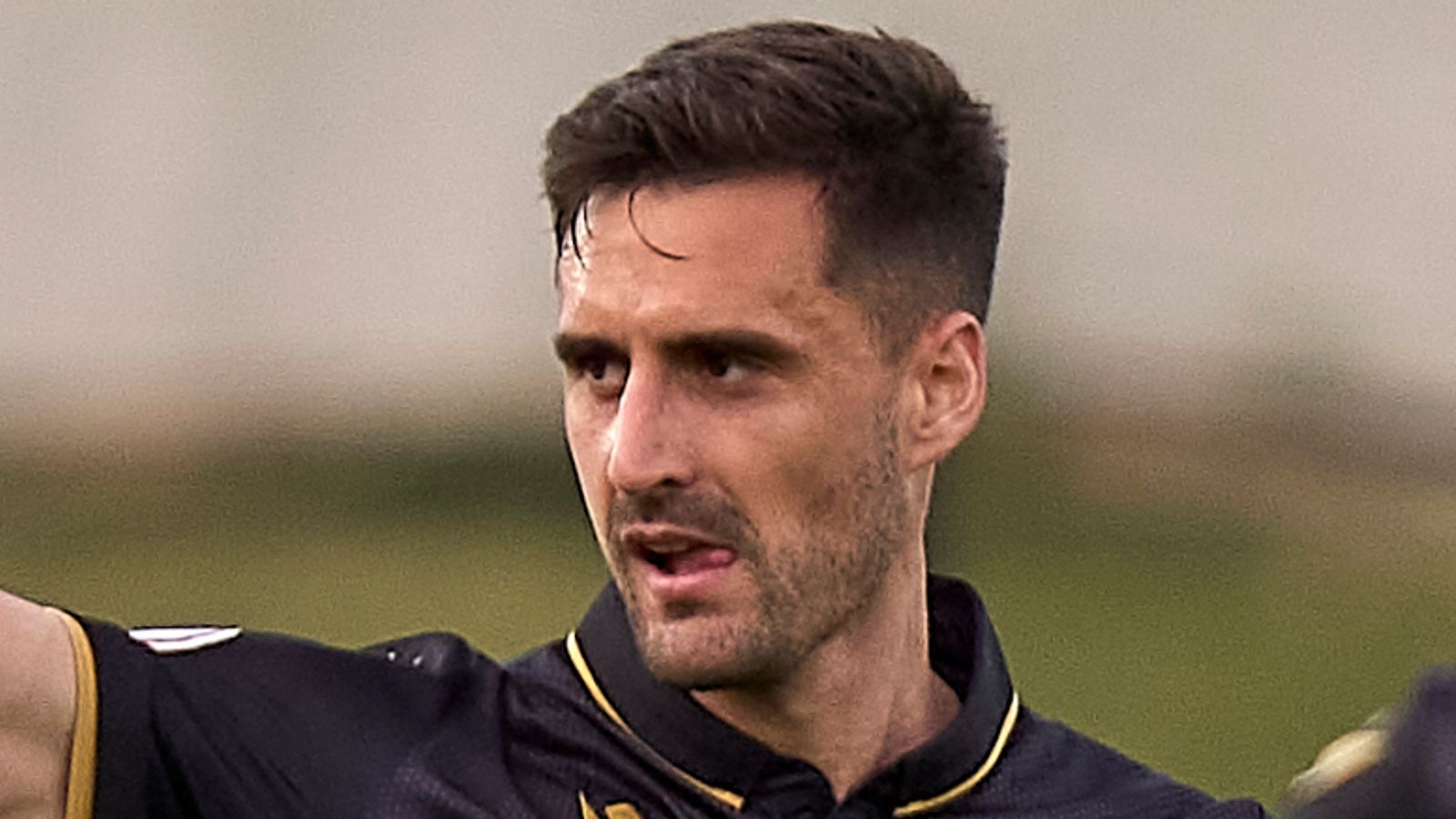
Spanish football woke up to devastating news on Tuesday. CD Tenerife striker Jesus de Miguel Alameda died in hospital at the age of 30, just hours after collapsing during a second-tier league match against FC Andorra. As Sky Sports reported on Tuesday morning, the forward suffered a cardiac arrest following a severe on-pitch collision.
The news hit the sport with staggering weight. De Miguel was an established professional entering what should have been the prime years of his life and career. Instead, an ordinary Monday night fixture in the Spanish second division turned into an unimaginable tragedy.
Supporters spent late Monday night clinging to every shred of medical information coming out of the hospital. Tenerife had initially released an update stating that the striker was admitted and remained stable despite the severe nature of his condition. That brief statement gave fans, teammates, and rival clubs a sliver of hope before dawn arrived.
Everything collapsed in the early hours of Tuesday morning. Club officials confirmed that De Miguel's clinical condition had worsened neurologically overnight. A few hours later, the club announced his passing, plunging Spanish football into genuine disbelief and mourning.
Tenerife released an emotional statement that captured the sheer shock felt across the Canary Islands and throughout Spanish football.
"Racked with pain, with a lump in our throats and unable to believe that this is true, from CD Tenerife we communicate the tragic passing of Jesus de Miguel Alameda."
The stoppage time collision and an absurd red card
Disaster arrived when the match was already effectively over. The referee had added substantial extra time, and the clock was ticking seven minutes into stoppage time when Tenerife launched one final long ball forward into Andorra territory.
FC Andorra goalkeeper Jesus Owono reacted by sprinting far outside his penalty area to clear the danger. De Miguel was tracking the flight of the ball at full speed, eyes locked on the drop. Neither man slowed down, and the resulting collision knocked De Miguel straight to the turf.
What happened next highlighted one of the most jarring disconnects between standard refereeing procedure and medical reality. While De Miguel lay motionless on the grass, the referee immediately reached into his pocket and flashed a red card at Owono. The goalkeeper was sent off on the spot before medical personnel could even begin chest compressions.
Showing a red card in that exact moment felt completely tone-deaf. Officials are trained to manage discipline, but pulling plastic on an opponent while a striker is dying on the pitch looks like mindless bureaucratic compliance. In a life-threatening medical emergency, nobody cares about match disciplinary sanctions.
The red card also ignored the sporting context of the play itself. Owono was not making a cynical tackle or attempting to hurt an opponent. He was a goalkeeper racing out of his penalty box on a desperate clearance attempt in the 97th minute.
Goalkeepers are coached to attack aerial balls outside their area. Strikers are taught to gamble on bounces and protect themselves in flight. When two athletes meet at full sprint, catastrophic collisions can happen without any malice.
Andorra were devastated by the consequence of the incident. The club later posted a message of profound sympathy on X, addressing the Tenerife community directly.
"With broken hearts and devastated, we want to send our most sincere condolences to the family of Jesus de Miguel, to all his team-mates, friends, and to CD Tenerife. Rest in peace."
Pitchside medical response and the reality of trauma
Once the severity of De Miguel's collapse registered, emergency personnel rushed onto the pitch. Medical staff treated the striker on the field for more than five minutes before moving him into an ambulance bound for the hospital.
Those five minutes felt like an eternity for everyone inside the ground. Both sets of players gathered around the scene in absolute silence, watching doctors and paramedics fight to stabilize the forward. Match officials officially abandoned the contest seven minutes into stoppage time as the ambulance hurried away.
As the original match report details confirmed, De Miguel had suffered a cardiac arrest following the impact. Sudden cardiac arrest caused by blunt-force chest impact remains one of the rarest and most terrifying events in sport.
The initial update from Tenerife on Monday night offered cautious relief. The club confirmed he was hospitalized and described as stable despite the severity of his condition. That diagnosis, however, masked the insidious nature of traumatic cardiac injury.
When an athlete suffers a cardiac arrest on the pitch, restoring a pulse is only the initial battle. Lack of oxygen to the brain during those minutes before resuscitation creates immense neurological danger. That reality hit home brutally when Tuesday morning's medical update reported that De Miguel had worsened neurologically overnight.
Modern football takes pride in its emergency training and rapid trauma response. Yet this tragedy demonstrates the harsh boundaries of sports medicine. Even with prompt care from stadium medical personnel, blunt trauma in competitive sport can turn fatal in an instant.
Scheduling paralysis and Javier Tebas's hollow hesitation
Following the confirmation of De Miguel's passing, LaLiga president Javier Tebas gave an interview to Television Canaria. Tebas expressed his profound shock at the news and promised that the league would make all its resources available to both Tenerife and De Miguel's family.
Tebas announced he would speak with Tenerife to consider postponing their next match this weekend. He pointed out the immense emotional difficulty Tenerife players would face if forced to compete so quickly after losing their teammate. He also raised the possibility of organizing a joint tribute involving clubs from both divisions of professional football.
Yet Tebas also added a line that raised eyebrows across the sport. He emphasized the need for reflection before deciding on specific measures. That hesitation felt completely unnecessary and detached from basic human empathy.
Why does the league need reflection to call off a football match? Tenerife cannot possibly take the pitch this weekend. Asking a group of footballers to focus on pressing triggers and set-piece marking four days after watching their teammate die is completely absurd.
Spanish football often gets trapped in administrative rigidity. Calendars are tightly packed with Segunda División rounds and cup ties. But fixture congestion is a paperwork problem, not a moral dilemma.
Every club in Spain would support an immediate postponement for Tenerife. LaLiga should have announced the cancellation right away. Forcing grieving players to wait while league executives reflect on logistical knock-on effects is a terrible look for Spanish football.
Solidarity across Spain and the long road ahead
While league administrators deliberated over scheduling logistics, condolences arrived from every corner of Spanish football. Real Madrid issued a formal communication expressing condolences and affection to De Miguel's family, teammates, and club.
Barcelona joined the mourning with a direct statement: "From FC Barcelona, we are deeply saddened by the tragic news of the passing of Jesus de Miguel, CD Tenerife player. Our thoughts and support are with his family, friends and loved ones during these difficult times."
LaLiga also posted a message of sympathy, sharing in the grief of the family and Tenerife supporters. Rivalries vanish instantly when tragedy strikes the pitch.
Tenerife's own words captured the lingering devastation better than any external message could. In their final statement, the club acknowledged that no sentiment could soften the blow: "There are no words of comfort; there is absolutely nothing that can alleviate this feeling overflowing with sadness."
De Miguel's family issued their own heartfelt message through the club. They thanked everyone for the overwhelming support received since Monday night. They also asked for the utmost respect for their privacy during this agonizing ordeal.
Tebas did make one point that deserves praise amid his administrative hesitation. The league president stressed that support for De Miguel's family and Tenerife must continue not only right now, but throughout the coming weeks and months. That support must be genuine and tangible, not just black armbands and a minute of silence before kickoff.
Jesus de Miguel lost his life chasing a football on a Monday night in November. At 30 years old, he had so much life and football ahead of him. The sport owes it to his memory to slow down, drop the bureaucratic excuses, and put human dignity before the calendar.
Read Next
- Jesus de Miguel dies at 30 following tragic on-field collision in Tenerife
- Arsenal are rushing to sign Junior Kroupi before PSG take control
- West Ham need an instant spark in Cardiff after ditching Nuno
- Declan Rice is running the Premier League and nobody can touch him
- ⚽ La Liga 2025-26 — Title Race Hub
- 🏆 Europa League Final 2026 — Full Coverage Hub