The Reprieve That Solves Nothing
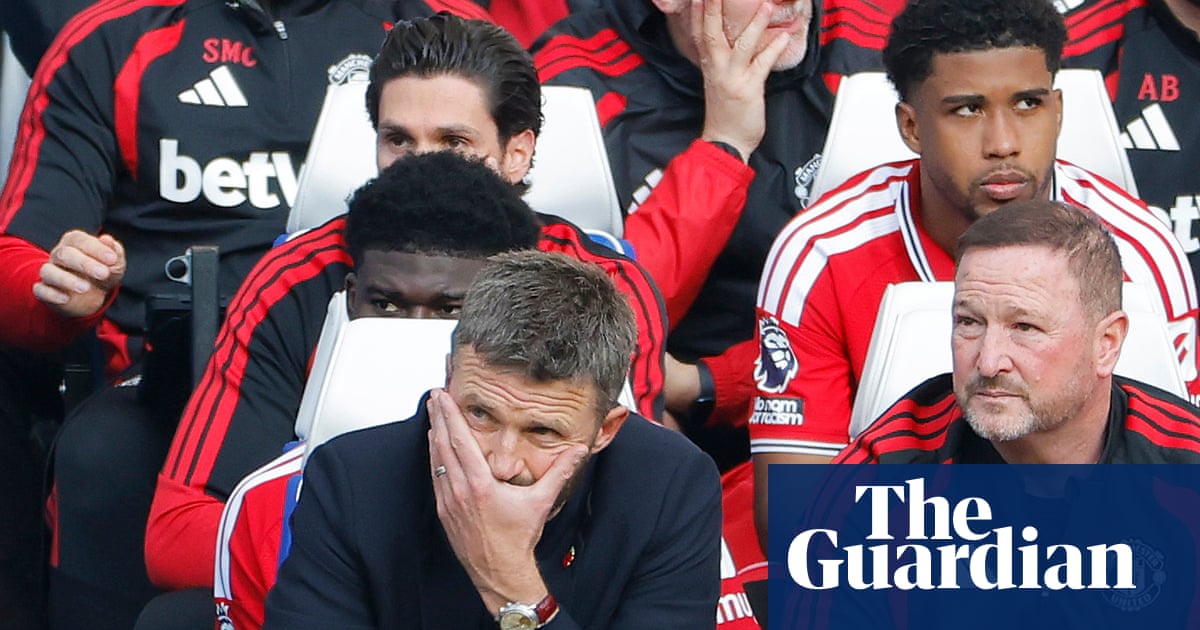
Michael Carrick lives to fight another night. The Manchester United manager will take his seat in the Old Trafford dugout on Tuesday when Roma arrive for matchday four of the Champions League. It looks less like an endorsement and far more like an administrative stay of execution.
Saturday’s 2-0 defeat at Stamford Bridge exposed every structural defect currently haunting this side. Chelsea sliced United open with elementary vertical passes, completely bypassing a midfield double pivot that repeatedly lost its bearings. That lifeless display stretched United’s winless run to nine games across all competitions.
You have to flick back thirty-eight years to find an autumn this bleak in Manchester. United sit 17th in the Premier League table with a meager seven points, dangling above the relegation zone solely on goal difference. It represents the club’s poorest start to a campaign since 1988, a statistical indictment that no boardroom can tolerate indefinitely.
As The Guardian reported, Carrick came remarkably close to losing his job last Monday. Director of football Jason Wilcox and chief executive Omar Berrada convened at Carrington for urgent talks regarding the manager’s standing. They opted for patience, gambling that Carrick can engineer an immediate rebound against Roma before hosting Aston Villa next Sunday.
That reprieve comes with explicit boundaries. United’s hierarchy plans to reassess Carrick’s future during the upcoming November international break, right after the Villa fixture. Carrick has roughly 180 minutes of competitive football to prove he has tactical answers to halt this downward spiral.
Carrick offered an uncomplicated summary after Saturday’s final whistle in London. He kept his public message brief and unvarnished.
"We’ve got to move forward and win matches, it’s as simple as that."
Simplicity, however, has abandoned United on the pitch. Winning matches requires spatial discipline, coordinated pressing triggers, and sharp build-up mechanics. Right now, Carrick’s setup delivers none of those basics.
Structural Breakdown in the United Pivot
Watch United out of possession and their tactical dysfunction is obvious. The frontline steps out to press in isolated bursts, chasing shadows without coordinated backing from the midfield line. That disconnect leaves thirty yards of unoccupied grass between the lines for opponents to exploit.
Chelsea tore through those vast chasms at Stamford Bridge. Moises Caicedo and Enzo Fernandez consistently found passing angles directly into the pockets behind United’s central pairing. When a midfield unit gets bypassed this routinely, center-backs are forced into panicked recovery challenges inside their own box.
Possession phases offer little relief. United pass the ball in an agonizingly slow, horseshoe shape around the opponent's defensive block. Center-backs split wide and trade lateral balls with the full-backs, lacking any penetration through central channels.
The build-up mechanics are fundamentally flawed. When United try to play out from the goalkeeper, the midfield pivot frequently drops too deep, bringing markers straight into the penalty area. Without third-man passing combinations or blindside rotations, the ball inevitably gets trapped against the touchline.
These technical breakdowns produce high-turnover catastrophes in dangerous sectors. Opposition sides do not need intricate tactical mastery to slice open this United defense. They simply sit in an organized mid-block, wait for a loose square ball, and sprint into wide-open transition corridors.
The travelling supporters in the Shed End still applauded Carrick at the conclusion of Saturday’s defeat. That loyalty speaks to his decorated playing career and his measured demeanor on the touchline. Yet goodwill evaporates quickly under European floodlights when passing becomes sluggish and mistakes multiply.
The Tactical Trap Roma Bring to Manchester
Roma present the exact stylistic matchup Carrick struggles to solve. Italian sides rarely beat themselves away from home in continental competition. They will happily surrender possession, pack the central zones with a back five, and dare United to break down a low block.
United have repeatedly stalled against disciplined, compact opposition this autumn. When Carrick’s attackers run out of passing lanes, they resort to hopeful, telegraphed crosses from deep positions. That approach plays directly into the hands of experienced, physical center-backs who dominate aerial duels.
The defensive counter-punch from Roma will be swift and dangerous. If United commit both full-backs high up the pitch to manufacture attacking width, they leave enormous acres exposed behind them. Roma’s direct forwards will relish targeting those vacant channels against retreating defenders in foot races.
Carrick lacks a dynamic ball-winning midfielder capable of extinguishing counter-attacks at source. His current options either lack the lateral mobility to cover wide spaces or the positional awareness to stop transitions early. In European football, failing to control defensive transitions is an express ticket to defeat.
Set-piece organisation is another glaring vulnerability for the home side. United have conceded far too many second-phase opportunities from dead-ball deliveries this autumn. Against an opponent that treats restarts as primary scoring weapons, any lapse in concentration will carry terminal consequences.
Carrick faces an acute tactical dilemma. Does he double down on his preferred possession-heavy philosophy, or does he adapt with a conservative, counter-attacking setup? Trying to impose an expansive game with a squad stripped of self-belief looks like tactical recklessness.
A compact 4-3-3 shape with narrow defensive spacing would offer far more stability. Yet throughout his tenure, Carrick has rarely shown an inclination to abandon his principles for pragmatic survival. That stubbornness might seal his fate against sharp Italian opposition.
Boardroom Division and the Prediction
The tension on the pitch mirrors a fractured reality within the executive boardroom. While Carrick prepares tactical drills for Tuesday night, the club’s sporting leadership is actively reviewing external replacements. At an elite club sitting 17th in November, contingency planning is standard practice.
Jason Wilcox has already determined his preferred candidate for the dugout. The director of football favors Eddie Howe, with contacts already established with Newcastle's former manager. Howe is reportedly open to the role, provided contract negotiations align with his professional ambitions.
Securing Howe would require United to pay roughly £3m in compensation to Newcastle. That figure represents loose change compared to the immense financial cost of missing European qualification entirely. Howe’s proven Premier League track record and aggressive tactical identity make him a safe domestic pair of hands.
Christopher Vivell, however, views the managerial direction through an entirely different lens. United’s director of recruitment strongly advocates for Julian Nagelsmann, having established a close working relationship with the German tactician during their shared time at RB Leipzig. Vivell is believed to have already sounded out Nagelsmann regarding his interest.
This split between Wilcox and Vivell reveals conflicting strategic visions at the highest level of the club. One director prioritizes Premier League stability and structured high-tempo pressing; the other desires European tactical sophistication and positional fluidness. That ideological friction creates a bizarre backdrop for Carrick’s remaining fixtures.
Dressing rooms detect political vulnerability instantly. Players understand that Carrick’s authority is hanging by a thread, which invariably affects commitment in fifty-fifty challenges and defensive tracking. When footballers know a manager is on borrowed time, collective discipline often begins to fray.
Carrick must somehow insulate his squad from the mounting noise outside Carrington. Every tactical decision against Roma will be scrutinized as a verdict on his future. If he benches senior names, critics will call it panic; if he maintains the status quo, detractors will call it complacency.
Tactically, Carrick must immediately reorganize his rest defense. When United push numbers forward into the final third, at least three defensive players must lock down the central corridor behind the ball. Leaving center-backs stranded against transitions is footballing suicide against European counter-punchers.
Ball circulation speed must increase dramatically from the opening whistle. Shuffling possession at walking pace will only allow Roma to comfortably reset their defensive block. United need sharp, one-touch passing between the lines to drag Italian markers out of central zones.
The atmosphere inside Old Trafford will hinge entirely on the opening quarter of an hour. A fast, purposeful start will rally a nervous home crowd and inject badly needed adrenaline into the players. Conversely, an early conceded goal or ten minutes of sterile backwards passing will turn the stands mutinous.
Individual accountability must return to United’s senior contingent. Too many seasoned internationals have drifted through matches during this nine-game slide, escaping primary scrutiny while the coach takes the heat. Leaders must demand the ball in tight spaces and track runners with genuine defensive commitment.
Sunday’s domestic clash with Aston Villa cannot enter Carrick’s thinking for one second. Rotating key personnel to preserve legs for the weekend would be an absurd tactical gamble. Carrick must field his strongest, most energetic lineup and treat Tuesday night like a knockout final.
Winning secondary duels will be the foundational battleground against Roma. Italian sides excel at winning the loose ball following contested aerial challenges, resetting attacks before opponents can reorganize. If United lose the physical battle in the center circle, their tactical shape will disintegrate once again.
Can Carrick conjure an inspirational European turnaround to save his managerial tenure? Under the floodlights at Old Trafford, football history always permits the possibility of an emotional resurgence. Yet tactical reality rarely yields to nostalgic sentiment.
Roma possess the tactical maturity, defensive discipline, and counter-attacking sharpness to frustrate a disjointed United team. They will soak up United’s sterile spells of possession, wait for the inevitable defensive error, and strike through rapid vertical transitions.
United will almost certainly display plenty of raw effort and nervous energy in the opening exchanges. Carrick will have them fired up to fight for their professional pride. But effort without positional structure only leads to exhaustion and defensive disorganization over ninety grueling minutes.
Expect a tense, frustrating night that ends in a 1-1 draw. That scoreline might technically keep Carrick in the dugout for Sunday’s visit of Aston Villa, but it will do nothing to halt the momentum behind Howe or Nagelsmann. Carrick’s time at Old Trafford is running out, and Roma will ensure the pressure only intensifies.
Read Next
- Michael Carrick says he is safe for Roma, but Old Trafford loves an ambush
- Man City's £325m midfield overhaul is already stalling
- Aston Villa suing Jamie Carragher is peak modern football comedy
- Lazio are scoring six away while playing to empty seats at home
- ⚽ Serie A 2025-26 — Title Race Hub (Inter, Napoli, Juve, Milan)
- 🏆 Europa League Final 2026 — Full Coverage Hub